No, this isn't some weird Food Network recipe. It's what I've been seeing in my backyard the past week.
The rabbits are cautious and are only around once it's dark. Even without turning on lights, I can spot the rabbit - it's a dark lump in the backyard where there shouldn't be one. And the dark spot moves occassionally.
The snow in the backyard is trampled with tracks from rabbits and squirrels. The rabbits have the night shift - the squirrels work during the day. Another difference is that the squirrels visit as a group - there were ten there one day last week. But the rabbits always show up only one at a time.
Different times to feed - different strategies for looking for food.
Wednesday, January 2, 2013

Thursday, December 27, 2012
Mystery Birds
Sometimes it's hard to identify the birds that show up at my feeders. They flit back and forth from feeder to bushes so quickly that much of the time it is hard to notice details. But you can figure out the identity of your mystery bird by using field guides. And not just one - I look at several since no one book has everything I need.
When you spot an unknown bird, look carefully at the size of the bird, the colors and patterns on the body and where they are located. Look at the feet - the color and size. But don't grab your field guide just yet. Your book will be there a long time, but the bird will fly off soon so spend time looking at the bird rather than flipping through pages in the book. If you've got a camera handy, snap a couple of shots - they may help.
Once the bird is gone, grab your field guides and start looking. Read the information in the guides - look at the drawings/photographs, read the descriptions, especially information describing behaviors. Look at the range maps, too.
Lately, there have been some birds coming to my window feeders. They're about the size of goldfinches - just a little smaller - and have some yellow splotches. But their chests are very striped. and the beak is small and pointy. They mix with the flocks of goldfinches. They eat similar foods - mainly thistle seed. Their call is a thin, reedy tee-tee.

So, who do you think the mystery bird is?
(They are pine siskins, periodic winter visitors to our area. )
When you spot an unknown bird, look carefully at the size of the bird, the colors and patterns on the body and where they are located. Look at the feet - the color and size. But don't grab your field guide just yet. Your book will be there a long time, but the bird will fly off soon so spend time looking at the bird rather than flipping through pages in the book. If you've got a camera handy, snap a couple of shots - they may help.
Once the bird is gone, grab your field guides and start looking. Read the information in the guides - look at the drawings/photographs, read the descriptions, especially information describing behaviors. Look at the range maps, too.
Lately, there have been some birds coming to my window feeders. They're about the size of goldfinches - just a little smaller - and have some yellow splotches. But their chests are very striped. and the beak is small and pointy. They mix with the flocks of goldfinches. They eat similar foods - mainly thistle seed. Their call is a thin, reedy tee-tee.

Use a couple of field guides and try to identify the bird shown above.
Some of my favorite field guides include:


I prefer regional guides to national ones since they focus on birds that are most likely to be found here in Minnesota. (If you want a guide for the larger area, choose one for the Eastern United States rather than the Western U.S. The dividing line is the Mississippi River and since it splits MN in half, you might think either guide would work fine, but the ones for the eastern birds will work better.)
So, who do you think the mystery bird is?
(They are pine siskins, periodic winter visitors to our area. )
Thursday, December 20, 2012
Safe from the Storm
It's snowing today - not as heavily as the big storm from a couple of weeks ago, but it's still coming down enough to limit visibility and make things challenging for man and beast. I'm interested in how the beasts are coping.
To help the birds in my backyard, I not only have feeders and a heated birdbath, but I've also made sure they have shelter. Trees and bushes are important as places for the birds to seek refuge from weather and from predators.
But another way I give them shelter is through brushpiles - a mound of branches of various sizes stacked about two feet high and three feet long. The birds, especially house sparrows, jump back and forth in and out of the branches, sometimes looking for food, other times getting away from the hawks that show up looking for a meal.
Today, I spotted the birds making use of another spot in the yard for their shelter. In anticipation of maple syruping in March, I started stockpiling wood that I can use for the fire to boil the sap into syrup. The wood is stacked up on pallets and covered with a tarp. This morning, I spotted house sparrows and juncoes hopping in and out of the fire wood pile.
Adaptable and curious, birds do what it takes to survive in Minnesota's changable weather.
To help the birds in my backyard, I not only have feeders and a heated birdbath, but I've also made sure they have shelter. Trees and bushes are important as places for the birds to seek refuge from weather and from predators.
But another way I give them shelter is through brushpiles - a mound of branches of various sizes stacked about two feet high and three feet long. The birds, especially house sparrows, jump back and forth in and out of the branches, sometimes looking for food, other times getting away from the hawks that show up looking for a meal.
Today, I spotted the birds making use of another spot in the yard for their shelter. In anticipation of maple syruping in March, I started stockpiling wood that I can use for the fire to boil the sap into syrup. The wood is stacked up on pallets and covered with a tarp. This morning, I spotted house sparrows and juncoes hopping in and out of the fire wood pile.
Adaptable and curious, birds do what it takes to survive in Minnesota's changable weather.
Friday, December 14, 2012
What do the crows know?
Remember Hitchcock's "The Birds"? Large flocks of menacing birds harrassing people in a town. Or have you read the Dauphne de Maurier short story called the "The Birds." Very creepy.
So, it's got me wondering - what's up with all the crows around the nature center lately? We've observed the injured crow we care for (named Diablo) pushing food out of its cage for the wild crows to eat. And there are always lots of tracks around his pen. But it's not just that there are lots of crows hanging out by Diablo.
Last week, about a dozen crows were chasing either a hawk or an owl by the Overlook Pond.
And multiple times over the past week, many on the staff have noticed 20-30 crows gathering on Marie Avenue near the entrance to the nature center. They'll be on the road (even when there doesn't seem to be any food for them to scavenge) and up in the trees, especially on the south side of the street. The crows wait until the last minute to get out of the way of the cars and then fly right back down to the street as soon as the vehicle has passed.
Bold, curious, gregarious - and very, very intelligent. What are the crows planning?
So, it's got me wondering - what's up with all the crows around the nature center lately? We've observed the injured crow we care for (named Diablo) pushing food out of its cage for the wild crows to eat. And there are always lots of tracks around his pen. But it's not just that there are lots of crows hanging out by Diablo.
Last week, about a dozen crows were chasing either a hawk or an owl by the Overlook Pond.
And multiple times over the past week, many on the staff have noticed 20-30 crows gathering on Marie Avenue near the entrance to the nature center. They'll be on the road (even when there doesn't seem to be any food for them to scavenge) and up in the trees, especially on the south side of the street. The crows wait until the last minute to get out of the way of the cars and then fly right back down to the street as soon as the vehicle has passed.
Bold, curious, gregarious - and very, very intelligent. What are the crows planning?
Wednesday, December 12, 2012
Sunrise...Sunset
Today's sunrise and sunset were beautiful. Both washed the horizon and tinted the clouds above with an unusually reddish-pink color. The old saying is "Red sky at night, sailor's delight; red sky at dawn, sailor be warned." The day brought us above average temperatures. Nothing disastrous but melting snow- it was quite the sloppy mess. So, that makes me wonder - if we have a day when both sunrise and sunset are red (and not because of smoke from fires), do the delight and warning cancel each other out?
 |
| Sunrise on 12-12-12 |
 |
| Sunset 12-12-12 |
Monday, December 10, 2012
Something Stinks
This past week, seventh graders visited the nature center to practice wilderness skills as a way to prepare for their trip to Wolf Ridge in January. They did a great job learning how to engineer a warm, dry shelter and build fires that could boil water. Two of the days were cold - it felt good to be wearing longjohns, winter coats, hats, and mittens.
But Thursday felt like a late spring day. It was in the high 40s by late morning. As the groups looked for branches to use in their shelters and fires, their teacher spotted a bright green stink bug.
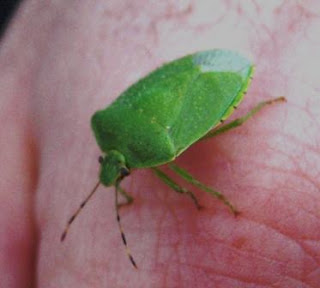
It's December. These bugs shouldn't be active anymore. But this one wasn't sluggish at all - just busy moving around.
An then, winter returned. Yesterday, Mother Nature dumped over 10 inches of heavy, wet snow on the southern part of the Twin Cities. (I got 10.5" in my backyard.)

I'm wondering where the stink bug is now and if it's even alive anymore. And more than just the stink bug, how many other animals were caught unprepared by the abrupt change? Some animals, like wood frogs, create an almost anti-freeze like substance within their bodies that let them freeze and survive winter's cold. As temperatures warm, chemical changes in the body break down the "anti-freeze" and the frog's metabolism revs up. This system gives the frogs a way to handle winter. But there has to be enough time for the frog to respond to changes in its environment.
For many animals, the amount of daylight is what triggers the changes to the body. But temperature affects some animals, too. And when we have these wild temperature swings, like the ones we've had this fall, it must impact certain animals. They can't adapt fast enough, so I guess, some days, it stinks to be a stink bug.
But Thursday felt like a late spring day. It was in the high 40s by late morning. As the groups looked for branches to use in their shelters and fires, their teacher spotted a bright green stink bug.

It's December. These bugs shouldn't be active anymore. But this one wasn't sluggish at all - just busy moving around.
An then, winter returned. Yesterday, Mother Nature dumped over 10 inches of heavy, wet snow on the southern part of the Twin Cities. (I got 10.5" in my backyard.)

I'm wondering where the stink bug is now and if it's even alive anymore. And more than just the stink bug, how many other animals were caught unprepared by the abrupt change? Some animals, like wood frogs, create an almost anti-freeze like substance within their bodies that let them freeze and survive winter's cold. As temperatures warm, chemical changes in the body break down the "anti-freeze" and the frog's metabolism revs up. This system gives the frogs a way to handle winter. But there has to be enough time for the frog to respond to changes in its environment.
For many animals, the amount of daylight is what triggers the changes to the body. But temperature affects some animals, too. And when we have these wild temperature swings, like the ones we've had this fall, it must impact certain animals. They can't adapt fast enough, so I guess, some days, it stinks to be a stink bug.
Thursday, November 29, 2012
NaNoWriMo Mania
So, for the past 29 days I've been busy writing - just not here. November is National Novel Writing Month (NaNoWriMo) - an insane, yet fabulous concept where you try to write a 50000 word novel between November 1 and November 30. That averages out to about 1667 words per day.
Well, I did it. I have successfully created a children's book that is over 50000 words long. Even though it isn't finished yet, I can say I have written at least the minimum of 50000 words. What a rush. I went into this with a general idea of what I wanted to have happen, but things happened that I never planned on - characters I never envisioned.
I'd read a book about what to expect when doing this and I'm so glad I did. The author, the guy who came up with this crazy idea, Chris Baty, says to expect this will be a crappy first draft, and let it be. More important is to get the ideas down. Then you can take the time you need to revise.
So, now that the 50000 words are out of my head and in my computer, I'll have time to get back to blogging.
Well, I did it. I have successfully created a children's book that is over 50000 words long. Even though it isn't finished yet, I can say I have written at least the minimum of 50000 words. What a rush. I went into this with a general idea of what I wanted to have happen, but things happened that I never planned on - characters I never envisioned.
I'd read a book about what to expect when doing this and I'm so glad I did. The author, the guy who came up with this crazy idea, Chris Baty, says to expect this will be a crappy first draft, and let it be. More important is to get the ideas down. Then you can take the time you need to revise.
So, now that the 50000 words are out of my head and in my computer, I'll have time to get back to blogging.
Subscribe to:
Posts (Atom)